In our previous article, we covered the high-tech world of asset tracking—RFID, RTLS, and AI-driven inventory systems. But technology alone doesn’t prepare a hospital for a disaster. When the supply chain is severed, the power grid is down, and staff are working under extreme pressure, Material Management becomes the department that determines whether the hospital can continue to function. This is the playbook for that moment.
The 96-Hour Mandate: An Accreditation Requirement
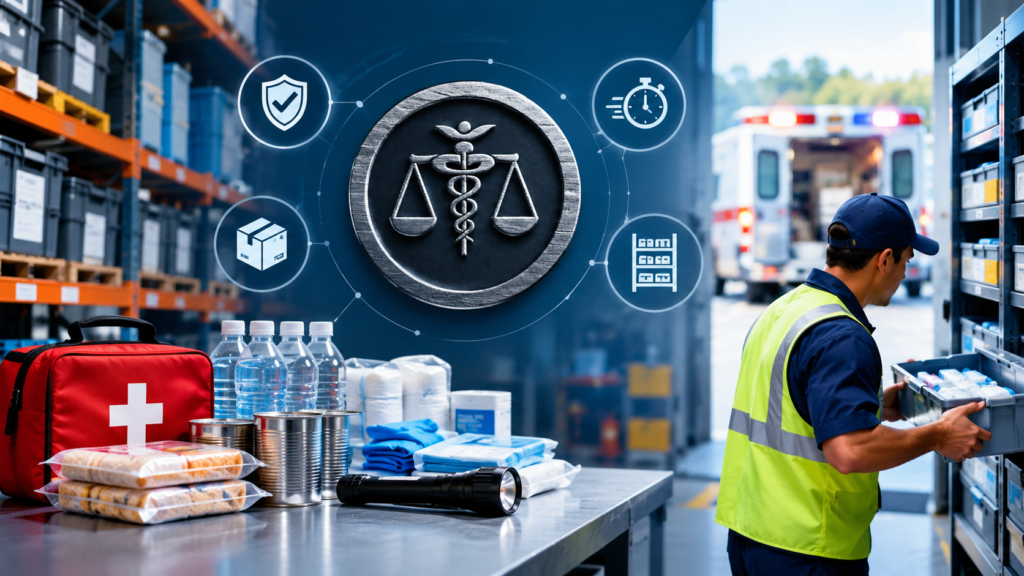
The first and most critical point to understand is that emergency supply planning is not optional—it is a core accreditation requirement. The Joint Commission mandates that hospitals must be self-sustaining for up to 96 hours during an emergency . This means a hospital must have a plan to sustain operations for four full days without outside support, based on calculations of current resource consumption . Failure to demonstrate a credible plan can result in citations and jeopardize accreditation.
This 96-hour requirement extends well beyond medical supplies. It encompasses:
- Water and fuel for essential operations, including generators
- Personal protective equipment (PPE) for staff safety
- Medical and surgical supplies and medications
- Food and dietary items for patients, staff, and essential visitors
The California Hospital Association’s guidance further clarifies that Title 22 regulations specifically require at least a one-week (7 days) supply of staple foods (non-perishable) and a two-day supply of perishable food on the premises, appropriate to meet patient dietary needs and restrictions . The Joint Commission also requires a documented inventory of resources and assets on site that may be needed during an emergency .
The Forgotten Dimension: Dietary and Food Supply Planning
Food supply is often the most overlooked aspect of emergency preparedness. Material Management must collaborate with Dietary and Clinical Nutrition to ensure that emergency food supplies meet the needs of all patient populations, including those on therapeutic or texture-modified diets . A hospital that stocks only peanut butter and crackers may find itself unable to serve patients with dysphagia (swallowing difficulties) or those requiring diabetic or low-sodium meals.
The Accreditation Commission for Health Care (ACHC) standards for Critical Access Hospitals require detailed policies addressing food storage, including :
- Rotation of stock and supplies to prevent expiration
- Monitoring and removal of outdated supplies
- Measuring and recording of refrigerator and freezer temperatures
- Proper labeling of food items with patient name, room number, and expiration date
- Separation of refrigerators for patient food, employee food, breast milk, and medications
Material Management should also consider the cold-chain requirements for temperature-sensitive items. Proper storage requires maintaining precise temperature ranges: refrigerators at 2–8°C for vaccines and biologics, freezers at -15 to -25°C for plasma, and ultra-low freezers at -60 to -86°C for mRNA vaccines . Each requires continuous monitoring, backup power, and alarm systems .
Smart Storage: Designing for Rapid Retrieval
In an emergency, speed is everything. A 2026 study on pediatric resuscitation found that reorganizing supplies using Lean methodology reduced the average time to locate essential items from 4 minutes and 27 seconds to just 2 minutes and 5 seconds—a difference that can directly impact patient outcomes.
Material Management can support rapid retrieval through several strategies:
1. Automated Storage and Retrieval Systems (AS/RS)
AS/RS uses robotics and software to store and retrieve products without manual handling. Key capabilities include :
- Space density: 50–85% floor space reduction
- 99.9%+ accuracy in inventory counts
- Full traceability and controlled access
- Dramatic labor savings: One case study documented a reduction in nurse time on stock orders from 2 hours 39 minutes to zero, with an 86% reduction in time spent on supplies organization
2. ABC/VED Analysis for Storage Prioritization
Not all supplies deserve equal storage attention. ABC analysis classifies items by consumption value, while VED classification assesses clinical criticality :
- High-value, vital items (AV): Need secure, climate-controlled storage with daily monitoring
- Low-value, desirable items (CN): Can use bulk storage with lean replenishment and monthly review
3. Point-of-Use Storage and Standardized Layouts
Decentralized storage at the point of care—such as automated dispensing cabinets and mobile carts—can cut nurse trips to central storage by 77–90%. Reorganization of internal storage has resulted in a 55% to 66% reduction in time spent collecting and storing materials . One case study documented 4,819 hours saved annually that were reallocated to patient care .
Can AI Play a Role? Absolutely.
Artificial intelligence is transforming emergency supply management in several powerful ways:
1. Predictive Demand Forecasting
Traditional estimation methods often produce significant inaccuracies, negatively affecting patient care and increasing waste . AI-driven predictive models can analyze transactional data, inventory records, procurement history, and patient inflow patterns to forecast demand with remarkable accuracy . One study demonstrated that a BiLSTM (Bidirectional Long Short-Term Memory) model achieved 97.59% accuracy in predicting medicine demand, with 92% precision and a 90.11% F1-score . These models can help reduce both stock-outs and overstocks in normal and emergency situations .
2. Automated Replenishment and Real-Time Visibility
AI-powered wireless weight-based bins can automatically monitor consumption and trigger reorders . Machine learning can refine storage decisions, including demand forecasting, safety stock optimization, and cold-chain anomaly detection . One study reported a 9% reduction in materials management labor costs through AI-driven automation .
3. Emergency Dispatch and Traceability
During emergencies, hospitals need systems that can quickly identify available resources and coordinate their deployment. One study found that incident coordination remains largely telephone-based, creating latency and loss of institutional memory . An “intelligence-ready” asset backbone would provide :
- Rapid device location and readiness status (e.g., battery status, calibration)
- Auto-generated task lists and traceable processes
- System-level prompts for inspections, calibration, and expiry management
- Dynamic distribution views letting staff see where items actually are by ward or operating room
4. AIoT-Enabled Green Supply Chains
The integration of Artificial Intelligence of Things (AIoT) enables real-time monitoring and dynamic demand forecasting, helping hospitals move beyond just-in-time delivery models that proved so vulnerable during the COVID-19 pandemic . Over 70% of healthcare facilities worldwide reported unbearable shortages of basic medical supplies during the pandemic, exposing critical vulnerabilities in traditional supply chain systems .
Securing the System: Documentation and Testing
A secure emergency supply system is about more than just physical storage. The Joint Commission requires a written plan for how resources and assets are documented, tracked, and monitored during a disaster . This plan must include :
- How the hospital will locate on-site and off-site inventories
- Processes for obtaining, allocating, mobilizing, replenishing, and conserving resources and assets
- Memoranda of Understanding (MOUs) with suppliers—though these are most useful during isolated emergencies and often fail during large regional events, which is why testing is essential
The Joint Commission also requires that plans be tested and documented through drills and exercises to identify weaknesses .
Final Pointers for Leadership
- Treat storage space as a strategic asset: The COVID-19 pandemic demonstrated the danger of relying solely on just-in-time supply chains. For a stand-alone 350-bed hospital, planning for a 90-day supply of PPE alone could require approximately 3,500 square feet of warehouse space . Secure this space now.
- Partner with Clinical Nutrition: Emergency food supplies must meet all patient dietary needs. Don’t wait for a surveyor to cite you for serving inappropriate food to patients with special dietary requirements.
- Test your plan: Having a plan is not enough. The Joint Commission requires that plans be tested and documented through drills and exercises .
- Consider AI-driven solutions: The technology exists to predict demand, automate replenishment, and provide real-time visibility into emergency supplies. The initial investment can pay dividends in lives saved and compliance maintained.
- Standardize for speed: Just as you would standardize a clinical device, standardize the organization of your supply rooms. It builds muscle memory and reduces cognitive load on staff in high-stress situations.
Your inventory system isn’t complete until you can survive 96 hours and find a critical item in under 2 minutes. Material Management holds the keys to both.
In our next article, we’ll explore how to build the business case for inventory automation—including the ROI calculations that will convince your board to invest.