
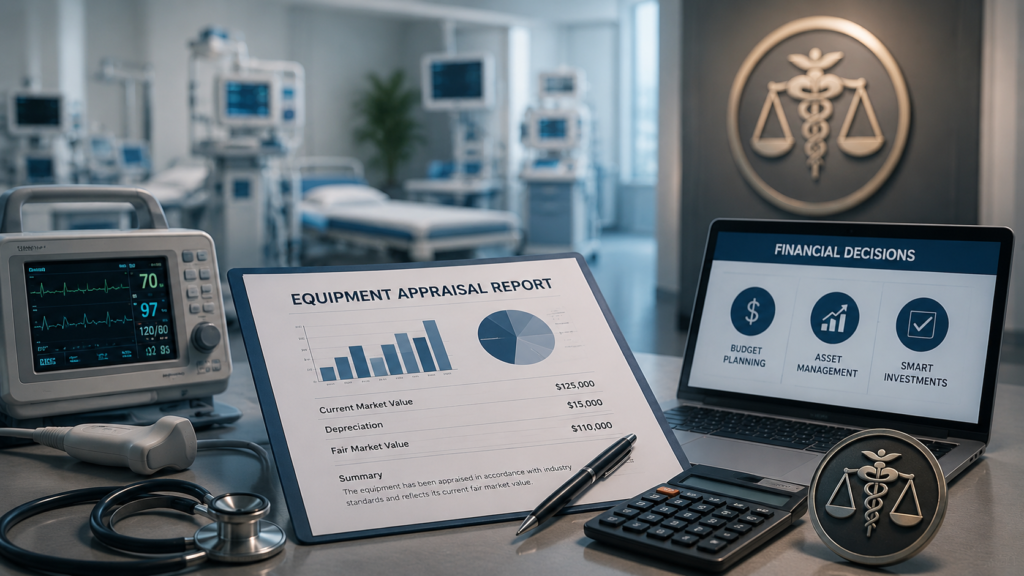
Summary: A medical equipment appraisal is an independent, professionally documented opinion of what your equipment is actually worth today — not what you paid for it, and not what your depreciation schedule says. Healthcare organizations use appraisals to strengthen capital planning, financial reporting, insurance coverage, transactions, and regulatory compliance. This article explains how appraisals work, when to obtain one, and why USPAP-compliant, defensible valuations matter.
Healthcare organizations invest heavily in the equipment that makes patient care possible — diagnostic imaging systems, surgical devices, laboratory instruments, patient monitoring, and the thousands of smaller assets that keep a facility running. For most hospitals, surgery centers, and physician practices, medical equipment represents one of the largest categories of tangible assets on the balance sheet.
Yet the value of that equipment is constantly moving. Technology advances, secondary-market demand shifts, usage and maintenance history accumulate, and regulatory changes can shorten an asset’s practical life overnight. Book value and original purchase price quickly stop reflecting reality. A professional medical equipment appraisal closes that gap, giving decision-makers a current, defensible number they can plan around.
What a Medical Equipment Appraisal Actually Measures
A qualified appraiser doesn’t guess at value — they build it from evidence. A typical engagement evaluates:
- Age, condition, and functionality of each asset, including maintenance and service history
- Remaining useful life, factoring in technological obsolescence and regulatory requirements
- Comparable sales in the secondary market for similar equipment
- Replacement cost — what it would take to acquire equivalent capability today
From this analysis, the appraiser develops the appropriate standard of value for your purpose. Fair market value — the price a willing buyer and willing seller would agree on, with neither under compulsion — is the most common. Depending on the assignment, a report may also address replacement cost for insurance purposes or liquidation value for lending and restructuring scenarios.
Reports prepared to the Uniform Standards of Professional Appraisal Practice (USPAP) carry particular weight. USPAP compliance means the methodology, data sources, and conclusions are documented in a way that auditors, lenders, courts, and the IRS recognize — which is what makes a valuation defensible rather than merely informative.
Capital Planning and Budgeting
Equipment replacement is one of the largest recurring capital demands in healthcare. An appraisal tells leadership which assets still hold meaningful value, which are approaching the end of their useful life, and what existing equipment could realistically contribute — through resale or trade-in — toward funding its replacement. Capital plans built on current market data are simply more accurate than plans built on depreciation schedules and estimates.
Financial Reporting and Audit Support
Asset values flow directly into balance sheets, depreciation, and impairment testing. When recorded values drift far from market reality, financial statements lose credibility. An independent medical equipment valuation gives finance teams — and their auditors — market-supported figures backed by a documented methodology. That documentation shortens audit cycles and strengthens the confidence of boards, lenders, and investors reviewing your financials.
Buying, Selling, and Equipment Financing
Healthcare facilities buy and sell equipment constantly, and every transaction benefits from objective pricing data. Before a purchase, an appraisal establishes whether the asking price reflects fair market value. Before a sale or trade-in, it tells you what to expect and gives you leverage in negotiation. Lenders frequently require an independent appraisal before financing equipment or extending asset-backed credit, and a USPAP-compliant report from a certified equipment appraiser satisfies that requirement.
Insurance Coverage and Risk Management
Insurance is where outdated values cost organizations real money. Policies based on original purchase price often leave equipment underinsured against today’s replacement cost — a gap that only becomes visible after a loss. Conversely, overstated schedules mean paying premiums on value that no longer exists. A current appraisal establishing replacement cost and fair market value lets risk managers right-size coverage, and provides ready documentation when a claim must be filed.
Mergers, Acquisitions, and Due Diligence
In healthcare M&A, equipment often represents a substantial share of the assets changing hands. An independent equipment appraisal supports due diligence, informs purchase price allocation, and gives both parties a neutral basis for negotiation. After closing, the same valuation data streamlines financial integration and establishes the acquirer’s opening asset records.
Tax, Donation, and Regulatory Requirements
Equipment valuations are frequently required for tax reporting, charitable donation substantiation, cost segregation, estate matters, and litigation. In regulated healthcare transactions, independent valuation also supports compliance: arrangements involving equipment leases or transfers between referral sources must generally be consistent with fair market value under federal fraud-and-abuse rules, and an independent appraisal is a key piece of that documentation.
Why Independence Matters
The value of an appraisal rests on the credibility of the appraiser. Independent valuation professionals apply recognized methodologies, current market research, and healthcare-specific expertise — free of any interest in the outcome. That independence is precisely what allows the report to stand up before auditors, lenders, regulators, opposing counsel, and the IRS. An internal estimate, however well-intentioned, cannot serve the same role.
Conclusion
Accurate, current equipment values touch nearly every significant financial decision a healthcare organization makes — budgeting, reporting, insurance, transactions, financing, tax, and compliance. A professional medical equipment appraisal replaces assumptions with defensible, market-based data.
American Healthcare Appraisal provides independent, USPAP-compliant medical equipment appraisals for hospitals, health systems, surgery centers, physician practices, and laboratories nationwide. Contact us to discuss your valuation needs.
Frequently Asked Questions
1. What is a medical equipment appraisal?
A medical equipment appraisal is an independent, documented opinion of an asset’s value — typically fair market value or replacement cost — based on its age, condition, remaining useful life, comparable market sales, and recognized valuation standards such as USPAP.
2. How is fair market value of medical equipment determined?
Appraisers analyze the equipment’s condition, functionality, and maintenance history; research recent sales of comparable assets in the secondary market; and adjust for technological obsolescence and regulatory factors to estimate the price a willing buyer and seller would agree on.
3. When should a healthcare organization obtain an equipment appraisal?
Before major transactions (purchases, sales, mergers, financing), at insurance renewal, ahead of audits, for charitable donations or tax filings, and periodically as part of capital planning — generally whenever a decision depends on knowing what equipment is actually worth today.
4. Who uses medical equipment appraisal reports?
Hospitals, health systems, surgery centers, physician practices, and laboratories rely on them, along with the lenders, insurers, auditors, attorneys, and investors who evaluate those organizations.
5. What makes an appraisal “defensible”?
A defensible appraisal is prepared by a qualified, independent appraiser following recognized standards (USPAP), with documented methodology and data sources — so the conclusion holds up under scrutiny from auditors, lenders, courts, and the IRS.