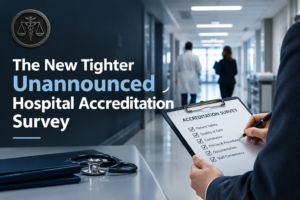
A 45-Year Surveyor’s Perspective on the New CMS Mandate
I remember it well as a CEO. The phone call would come: “There are surveyors in the lobby.” A thousand questions would swirl through my mind. Why are they here? What did we do? And then, the scramble would begin.
For decades, that was the pattern. Hospitals would operate with a certain level of compliance, then panic when a survey was announced, scrambling to fix deficiencies, polish documentation, and train staff at the last minute. It was stressful, inefficient, and—frankly—unsustainable.
But here is the reality: that era is over—and it has been for a long time.
The CMS Mandate: Unannounced is the Law
Many hospital administrators still believe that unannounced surveys are a new trend or apply only to certain accrediting bodies. That is a dangerous misconception.
The Centers for Medicare & Medicaid Services (CMS) has long required that all surveys of providers and suppliers be unannounced. The policy is designed to ensure that surveyors can observe the facility as it “typically operates,” rather than seeing a facility that has made unusual preparations—extra cleaning, calling in extra staff, temporarily correcting deficiencies—that would not represent the true quality of care provided.
But here is where it gets even more critical. In June 2026, CMS issued a final rule that formally codifies unannounced surveys as a firm requirement for all CMS-approved accrediting organizations. The rule, set to take effect June 16, 2027, explicitly defines an unannounced survey as:
“A survey that is conducted without any prior notice of any type, through any means of communication or forums, to the facility to be surveyed, and therefore, is unexpected to the facility until the arrival onsite by surveyors.”
This means that even administrative contacts—like notifying a facility via email or portal 15 to 60 minutes before arrival—are now considered violations of the unannounced survey requirement. The rule also prohibits practices like allowing facilities to request “blackout dates” when they prefer not to be surveyed.
Survey teams would often call the hospital the morning of the survey to let the executives know that surveyors were en route and would want to convene an opening conference with administration and department heads, in an effort to launch the survey expeditiously and avoid confusion and delays to the survey.
That will no longer is allowed as of June 17, 2027.
All Accrediting Bodies Must Comply
The final rule applies to all nine CMS-approved accrediting organizations, including:
- The Joint Commission (TJC)
- DNV GL Healthcare
- HFAP / ACHC
- AAAHC
- Quad A
- CHAP
- CIHQ
- NDAC
- The Compliance Team
In other words, there is no exception. Every accrediting body with CMS deeming authority is now, and has always been, expected to conduct unannounced surveys. If you are a hospital administrator who believes you will get advance warning, you are operating under a false assumption—and that assumption could cost you your accreditation.
Why “Batch Preparation” Fails
The time old model of batch preparation—waiting until you know a survey is coming, then scrambling to get ready was flawed for several reasons:
1. You Cannot Fix Years of Neglect in Weeks
A gap analysis conducted the week before a survey will inevitably reveal deficiencies that cannot be resolved overnight. Missing or outdated policies, inconsistent implementation of procedures, insufficient training or staffing levels—these are not quick fixes. I have walked into facilities days before a survey and found problems that would take months to properly correct.
2. Surveyors Can Spot a Scramble
After 45 years on the other side of the table, I can tell you: we knew when a facility was scrambling. Disorganized documentation, staff who clearly had not been trained, administrators who could not find key policies—these red flags were impossible to miss. Surveyors are trained to recognize the difference between a facility that operates with excellence every day and one that is putting on a show.
3. The Stakes Are Higher Than Ever
A failed survey can mean denied reimbursements, loss of accreditation, or even termination of a Medicare provider agreement. In today’s healthcare environment, that is an existential threat. With the new CMS rule making unannounced surveys universal, there is no longer any room for complacency.
The Solution: A Culture of Continuous Compliance
The answer is not to work harder when a surveyor shows up—it is to build a system that is always survey-ready. Here is how:
1. Make Accreditation a Continuous Process
Hospital accreditation should be a continuous process rather than a once-every-three-year experience you forget about until it happens again. Compliance should be embedded in your daily operations, not treated as a special event. When accreditation is part of your culture, an unannounced survey is not a crisis—it is just another day.
2. Form a Dedicated Readiness Committee and Designated Chair
Do not handle this solo—teamwork is essential. Establish a dedicated team comprising representatives from various departments that is responsible for accreditation readiness. Collaborate to review accreditation standards, pinpoint gaps, formulate policies and procedures, coordinate educational sessions, and ensure thorough documentation review.
3. Conduct Regular Internal Assessments
Simulate accreditation surveys through mock survey exercises conducted internally or with the assistance of external consultants. These simulations help identify areas of noncompliance, gaps in processes, and areas needing improvement. Use the feedback obtained to refine policies, procedures, and workflows. The goal is to find deficiencies before the real surveyors do.
4. Invest in Staff Training and Education
Investing in staff training and education programs enhances awareness of accreditation standards, regulatory requirements, and best practices. Conduct regular training sessions covering topics such as infection control, emergency preparedness, patient safety protocols, and compliance with regulations. Remember: having policies is not enough—staff must be educated on them and able to demonstrate their knowledge.
5. Have a Plan for the Unexpected
Given that unannounced surveys are now firmly mandated, a best practice is to treat the possibility like any other operational event and make a plan. Designate key individuals who will manage the survey, establish notification protocols, identify a command center with a coordinator, and develop detailed debrief instructions to follow after the event. When the surveyors arrive, your team should know exactly what to do.
The 45-Year Perspective
I have been on both sides of this process. I have conducted thousands of surveys for Medicare and accrediting bodies over 45 years. I have seen the panic in administrators’ eyes when they realize they are unprepared. And I have seen the quiet confidence of facilities that operate with excellence every single day.
Here is the truth: the facilities that thrive are those that embrace continuous compliance as a core operating principle, not a periodic exercise.
Unannounced surveys are not going away. The new CMS rule makes that crystal clear. But with the right preparation, an unannounced survey does not have to be a source of fear. It can be an opportunity to demonstrate the quality of care you deliver every day.
How Accreditation Consultants Can Help
If your facility is struggling to maintain continuous compliance—or if you are a new hospital, a Rural Emergency Hospital (REH), or a facility that has never been surveyed—working with experienced accreditation consultants can be a game-changer.
At AHCA, our team brings 45 years of direct surveyor experience. We know exactly what surveyors look for, how they think, and where hospitals most commonly fail. We provide:
- Gap analyses and readiness assessments to identify deficiencies before the real surveyors arrive
- Policy and procedure development to ensure your documentation is complete and compliant
- Staff education and training to build a culture of continuous compliance
- Mock surveys to simulate the real experience and build confidence
- Interim management to guide your facility through critical transitions
Do not wait until the surveyors are in the lobby. Build a culture of continuous compliance today.
About the Author: With over 45 years of experience as a Medicare and accreditation surveyor, our team at AHCA has conducted thousands of surveys across the U.S. and some international hospitals.