By Bruce Krider, MHA – American Healthcare Appraisal LLC
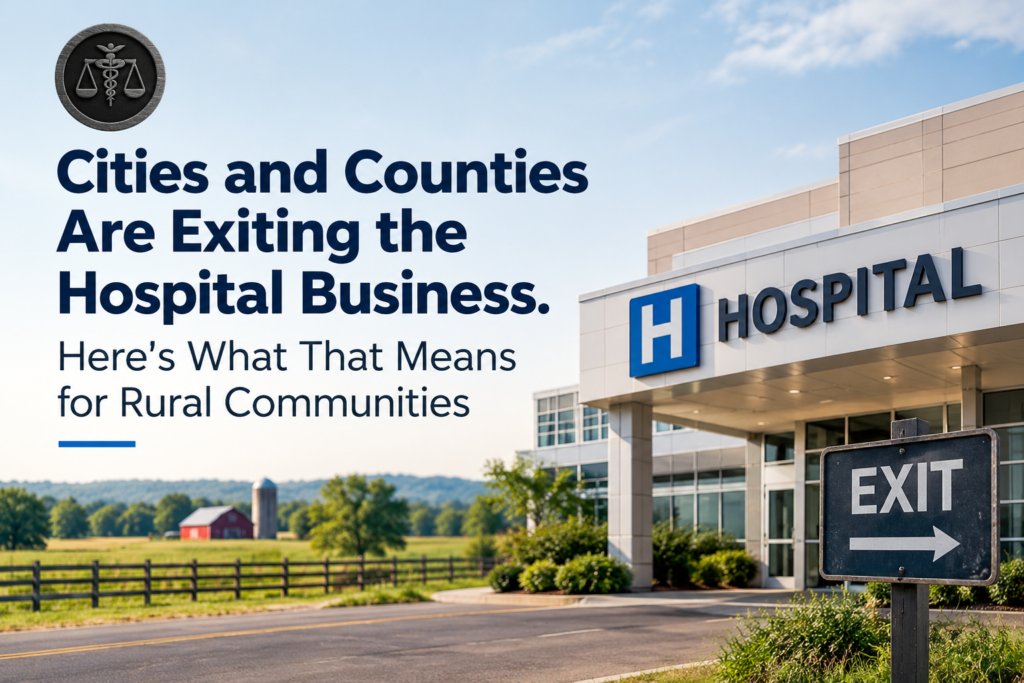
A growing number of cities and counties across the United States are reaching the same conclusion: they can no longer afford to run their own hospitals. From Tennessee to Florida to North Carolina, local governments are exploring sales, leases, and conversions, driven by years of mounting losses, the inability to recruit physicians and experienced administrators, and the sheer complexity of operating a healthcare facility in an era of shrinking reimbursements and rising costs. For many communities—especially rural ones—the question is no longer whether to stay in the hospital business, but how to exit it in a way that preserves at least some access to care.
The Financial Case for Exit
The numbers tell a stark story. Half of all rural hospitals are operating in a deficit, a figure that has jumped nearly 7% in a single 12-month period—the biggest increase researchers have seen since they began tracking the issue. More than 40% of rural hospitals are losing money on patient care, and almost one-third recorded overall losses in 2024–2025 despite receiving local tax support. Since 2005, 247 rural hospitals have closed or ceased providing inpatient services. An additional 338 are at particular risk of closure, conversion, or service reductions.
For city and county governments, these losses translate directly into budget pressure. Williamson County, Tennessee, for example, proposed selling its hospital, Williamson Health, in November 2025 with the explicit goal of alleviating the county’s $1.1 billion debt. In Adams County, Washington, the public hospital district lost $14 million over five years, leaving it with an “extremely high accounts payable in the $3 million range”. The district’s newly hired CFO laid out the options plainly: bankruptcy, closure, consolidation, merger, restructuring, partnerships, increased levy dollars, grants, or sale of assets.
These are not isolated cases. Watsonville Community Hospital in California lost $22.4 million in 2025 and faced a daily cash shortfall of $85,000, with its board acknowledging it was “difficult to forecast how the organization can meet its payroll and accounts payable obligations in the future”. Elbert Memorial Hospital in Georgia, a 25-bed critical access facility, asked both its county and city for $250,000 each just to sustain operations; the county’s funding request did not move forward.
Why Rural Hospitals Struggle
The financial distress of rural hospitals is not a story of mismanagement alone. It is structural. Rural hospitals face low patient volumes, which—paired with the fixed costs of maintaining a 24/7 emergency department, surgical suites, and inpatient beds—leads to higher per-patient costs. Reimbursement from Medicare, Medicaid, and commercial payers frequently fails to cover the actual cost of providing services. While supplemental programs exist, they are not enough to offset deficits caused by other payers, especially Medicare Advantage plans.
Workforce challenges compound the problem. America is projected to face a total shortage of 187,000 physicians by 2037, with rural areas experiencing shortages of 60% compared to just 10% in urban areas. Only 2% of medical residencies are located in rural areas, and rural hospitals often lack the resources, staff, and patient volume to start their own residency programs. Lower reimbursement rates—up to $70,000 less per resident for certain rural hospitals—further discourage investment in training the next generation of physicians. As one Missouri hospital administrator put it, starting a family medicine residency program would cost his hospital close to $100,000 per resident based on current estimates.
Recruiting experienced hospital management is equally difficult. Rural hospitals often lack the organizational depth to address the many challenges they face today: revenue cycle management, payer negotiations, regulatory compliance, technology adoption, and strategic planning. As one rural CEO observed, financial survival has become “a daily discipline requiring thoughtful decision-making,” where the CEO must be personally involved in the revenue cycle and make decisions on a daily basis about how to lead the organization. Not every small community has access to that level of leadership.
The Alternatives: Closing, Selling, or Converting
When a city or county decides to exit the hospital business, three broad paths emerge: closure, sale or lease to another operator, or conversion to a different facility type.
Closure is the most drastic option and the one communities most want to avoid. But it is sometimes the only financially viable choice. Martin General Hospital in Williamston, North Carolina, closed in August 2023 after filing for bankruptcy. The Martin County board of commissioners subsequently voted to sell or lease the facility, with the chair stating, “Whether we lease or sell, our end goal is to get a provider in there to start servicing the citizens of our community once again”.
Sale or lease to a larger health system, a regional operator, or a private entity is increasingly common. DeSoto Memorial Hospital in Florida launched a Request for Proposal process after an outside health system approached it about a sale, with several larger hospital systems expressing interest. In Tallahassee, the city is negotiating the sale of Tallahassee Memorial HealthCare to Florida State University, aiming to develop an academic medical center model. The city hired a consulting firm to conduct six different valuations, which produced a range of $26 million to $220 million if debt is included, or $109 million to $584 million if debt is excluded.
One critical legal wrinkle: many states require that proceeds from the sale of a government-owned hospital be placed into a trust for healthcare-related purposes. Williamson County officials are pushing for state legislation that would allow sale proceeds to be used to pay down county debt instead. As one state senator noted, “Some home hospitals might want to consider being sold (because) that could generate a lot of proceeds,” and the bill would allow counties to “utilize some of those proceeds for another purpose should they decide to do so”.
Conversion to a Rural Emergency Hospital (REH) has emerged as a middle path. Created by the Consolidated Appropriations Act of 2021 and effective January 2023, the REH designation allows eligible rural hospitals to give up inpatient acute care beds and operate as a 24/7 emergency department with observation care and outpatient services, keeping the annual per-patient average length of stay under 24 hours. In exchange, REHs receive an additional 5% above standard Medicare outpatient rates and a fixed monthly facility payment—approximately $285,625 per month in 2025.
The model has shown promise but modest uptake. As of March 2026, only 44 hospitals had transitioned to REH status out of approximately 1,500 eligible facilities. Early data suggests that converters had negative margins and were at high risk of closure, and that conversion improved profitability and avoided closure. “We would be going out of business if we didn’t” convert, said one hospital administrator. Another noted that his hospital was already operating like an REH—only about 5% of its volume was inpatient—but wasn’t receiving the reimbursement.
Challenges remain. The loss of inpatient services is the most frequently cited negative impact, along with reduced inpatient revenue and the loss of long-term care beds. Community acceptance can be difficult, particularly in areas with older populations where the local hospital is often the only inpatient provider. State-level implementation has also been uneven; some hospitals experienced delays in receiving the monthly stipend, and some states have been slow to adapt their own regulations to the new federal model.
The Importance of Valuation and Positioning
Whether a community chooses to sell, lease, or convert, the process begins with an accurate valuation. Hospital valuation is not a simple exercise. Healthcare businesses carry distinct financial, regulatory, and operational considerations that require specialized expertise. Courts and regulators generally rely on fair market value—what a willing buyer would pay a willing seller in an arm’s-length transaction. Disputes can arise when owners focus on investment value (what the hospital is worth to them personally) while the law requires fair market value.
The stakes of getting valuation wrong are high. In Massachusetts, the state’s eminent domain takeover of St. Elizabeth’s Medical Center’s Brighton Campus resulted in a $66 million settlement—nearly 15 times higher than the state’s original offer of $4.5 million. For local governments, overpaying or accepting too little for a community asset can have lasting fiscal consequences.
A robust valuation typically employs multiple methodologies. In Tallahassee’s case, the city’s consultant used six different approaches, including sales comparison, cost, and income approaches, producing a wide range of values depending on assumptions about debt and market conditions. Florida law requires that any sale or lease of a public hospital be for fair market value, supported by independent analysis and findings.
Positioning the hospital for the best possible outcome also means thinking beyond the transaction itself. Communities that have successfully transitioned their hospitals have often done so through partnerships with regional health systems that bring management depth, payer relationships, and economies of scale. Daviess Community Hospital in Indiana shifted from losing millions monthly to posting positive margins within six months of entering a management arrangement with a regional health system built around keeping care in the communities it serves.
For communities considering an REH conversion, thorough preparation is essential. Leaders who have been through the process recommend spending a year or more reviewing patient volumes, financial implications, workforce considerations, and community impact before deciding to convert. The Rural Emergency Hospital Technical Assistance Center offers resources and one-on-one guidance before and after conversion to help communities make informed decisions.
A Difficult but Necessary Reckoning
The trend of cities and counties exiting the hospital business is not a sign that local leaders have stopped caring about healthcare. It is a recognition that the traditional model of municipal hospital ownership—built for a different era of healthcare finance and delivery—is increasingly unsustainable. Rural hospitals today face a combination of forces that no single small community can overcome alone: declining populations, aging infrastructure, workforce shortages, reimbursement shortfalls, and the growing dominance of large health systems and Medicare Advantage plans.
The path forward will look different in every community. Some will sell to larger systems. Some will convert to rural emergency hospitals. Some will close. Some will find innovative partnerships that preserve access while transferring financial risk. What they share is the need for honest assessment, careful valuation, and strategic positioning. As one rural CFO put it, “If we don’t make any money, it’s hard to provide good healthcare. You don’t have the ability to bring services, you don’t have the ability to buy supplies, pay your staff”. The decision to exit the hospital business is difficult. Making it without a clear-eyed understanding of the hospital’s value and the community’s options makes it harder still.
The Federal Hammer: How the One Big Beautiful Bill Made a Bad Situation Worse
If the structural problems facing rural hospitals were already severe, the One Big Beautiful Bill Act (OBBBA), signed into law in July 2025, turned them into an existential crisis. The legislation—which Republicans often refer to as the “Working Families Tax Cut Act”—slashed more than $1 trillion in federal support for health care, with Medicaid bearing the brunt of the reductions. The Congressional Budget Office estimates the Medicaid cuts alone will leave 7.5 million more people uninsured over the next decade, with other provisions pushing that figure to 10 million. Federal Medicaid spending is projected to fall by more than $900 billion over ten years—a reduction that disproportionately falls on rural communities, where a higher proportion of residents rely on Medicaid.
For rural hospitals already operating on thin or negative margins, the timing could hardly be worse. Nearly 200 rural hospitals have closed or stopped providing inpatient care since 2005, and the Sheps Center at the University of North Carolina estimates that over 338 rural hospitals are at particular risk of closure, conversion, or service reduction because of these cuts—either because they serve a high share of Medicaid patients, have experienced three consecutive years of negative margins, or both. Chartis, a healthcare advisory firm, estimates the policy-driven cuts could cost rural hospitals nearly $140 billion in future losses.
The damage is not theoretical. It is already visible in communities across the country. In northeast Georgia, St. Mary’s Sacred Heart Hospital ended labor and delivery services, forcing expectant mothers to drive an extra hour for care. In Nevada, Boulder City Hospital converted from a Critical Access Hospital to a Rural Emergency Hospital, losing inpatient services and facing a 50% reduction in supplemental Medicaid provider tax revenue—a devastating blow for a facility already operating on slim margins. In Colorado, the CEO of Lincoln Health, an independent critical-access hospital in Hugo, described the situation bluntly: “We tend to run with 30 to 40 days cash on hand. I don’t have the kind of reserves to keep going”. Donna Lynne, CEO of Denver Health, warned that the most devastating cuts will hit in 2028, when Medicaid reimbursement rates to providers are drastically reduced.
The legislation’s damage operates through several mechanisms. The OBBBA imposed the first-ever work requirements on Medicaid, adding administrative burdens that will cost hospitals and health centers millions to comply with. Donald Moore, CEO of Pueblo Community Health Center, estimated his facility alone would spend $5.6 million in the next fiscal year just to comply with the new rules. The law also curtailed states’ ability to levy taxes on health care providers—a critical funding mechanism that many states use to draw down additional federal Medicaid matching funds and supplement hospital reimbursement rates. In Illinois, the state is projected to face a $48 billion cut in Medicaid funding, forcing hospitals to potentially reduce workforce, mental health and obstetrics services, and close facilities.
Congress did create a $50 billion Rural Health Transformation Program (RHTP) as part of the OBBBA, allocating $10 billion annually from 2026 to 2030 to help offset the Medicaid reductions and improve rural health infrastructure. But the program’s structure has drawn sharp criticism. Provider payments cannot exceed 15% of program funds in a given year, and states cannot spend more than 20% on capital expenditures and infrastructure—limits that restrict direct relief to struggling hospitals. Four senators, including Maine Republican Susan Collins, sent a letter to CMS Administrator Mehmet Oz warning that the fund’s structure “may unintentionally disadvantage many of the rural hospitals and clinics the program was intended to support”. The Chartis analysis concluded that the $50 billion investment, while historic, is “not sufficient to counter structural financial pressures” and “may be too late to prevent more hospitals from closing their doors or removing service lines”.
The political fallout has been swift. CNN reported in March 2026 that hospitals across the country—from northeast Georgia to rural New Hampshire to Des Moines, Iowa—were citing the bill as a factor in decisions to close maternity wards, shutter community health centers, and lay off employees. “Our health care system was already fragile and now the largest cuts in health care history are going to disintegrate it further,” said Vaishu Jawahar of the advocacy group Protect Our Care. Senator Catherine Cortez Masto of Nevada, who visited Boulder City Hospital after its conversion, put it plainly: “With the cuts in Medicaid, which I did not support, we are seeing challenges to our entire hospital system throughout the state”.
For city and county officials weighing whether to sell, lease, or close their hospitals, the OBBBA has fundamentally altered the calculus. The federal government has effectively told rural communities that the safety net they have relied on for decades will be thinner, less predictable, and harder to access. The Rural Health Transformation Program offers some relief, but it is a five-year infusion—not a permanent fix—and its funding is dwarfed by the Medicaid cuts it was meant to offset. As one rural hospital CEO observed, “You can only do that so long”. The question facing local governments is no longer whether they can afford to stay in the hospital business. It is whether they can afford to stay in it alone.
American Healthcare Appraisal LLC partners with healthcare providers—including rural and small hospitals—to identify challenges, analyze performance, maximize strengths, and minimize weaknesses so they can remain viable participants in the communities they serve. To learn more, visit www.ahca.com.