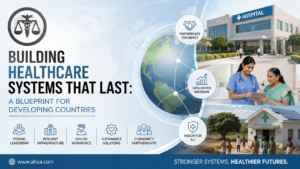

How One Firm’s 40-Year Track Record Across Six Continents Delivers Hospital Projects That Operate with Excellence from Day One
When governments and international consulting firms undertake the development of a new hospital abroad, they face a daunting reality: a state-of-the-art facility is only half the battle. The true challenge lies in ensuring that hospital operates with excellence—staffed by qualified professionals, governed by sound bylaws, and accredited by recognized international bodies.
For over 40 years, our firm has guided hospital projects across South America, the Middle East, Eastern Europe, the Pacific Rim, and Asia. We have learned that three pillars determine whether an international hospital project succeeds or fails: staffing, governance, and accreditation. These are not separate concerns—they are deeply interconnected. And addressing them requires expertise that goes far beyond construction management.
The Staffing Challenge: Recruiting, Organizing, and Retaining Talent
International hospital projects face unique staffing challenges that domestic projects rarely encounter. Language barriers, cultural differences, immigration complexities, and varying clinical training standards all create obstacles to building a capable workforce.
The International Recruitment Landscape
Many countries pursuing international hospital development face a critical workforce paradox: they are building world-class facilities but may not yet have a domestic workforce with internationally recognized credentials to staff them. As one healthcare leader noted, without aligning medical education standards with international benchmarks, new international hospitals risk being “dominated by foreign professionals rather than local talent” .
This is where ethical, strategic international recruitment becomes essential. Successful international staffing requires more than simply filling positions—it demands a workforce governance approach that prioritizes transparency, clinician protection, and long-term integration . Healthcare organizations that treat ethical recruitment as a workforce governance issue—not just a legal checkbox—see stronger clinician retention, fewer integration disruptions, and more sustainable long-term staffing outcomes .
Building a Sustainable Staffing Model
For governments and consulting firms developing hospitals abroad, our approach focuses on:
1. Strategic Workforce Planning
We help identify current and future staffing gaps by analyzing patient demographics, service line requirements, and projected growth. This includes anticipating seasonal surges, planned leave, and retirement dates that can create critical staffing vulnerabilities .
2. Ethical International Recruitment Frameworks
Our staffing models are built around clear ethical standards: transparent contracts and informed consent, clear visibility into immigration timelines, protection of clinician rights, and structured support before and after arrival . This approach reduces turnover and strengthens workforce stability.
3. Medical Staff Organization and Bylaws
Every hospital requires clear organizational structures that define clinical privileges, credentialing processes, peer review mechanisms, and medical staff accountability. We help draft medical staff bylaws that align with international best practices while respecting local legal and cultural contexts.
4. Interim Management During Transition
New hospitals rarely have their full permanent leadership team in place at opening. Our interim management services provide experienced on-the-ground leadership during the critical pre-launch and early operational phases, ensuring continuity while permanent staff are recruited and onboarded.
5. Staff Education and Training Programs
Having policies is not enough—staff must be trained to implement them. We develop tailored education programs that prepare clinical and administrative teams to operate within new infrastructure, follow accreditation standards, and deliver care consistent with international quality expectations.
The Governance Challenge: Building Structures That Last
International hospitals often operate in complex environments where governance structures may be less established or where political and organizational dynamics create unique challenges.
Why Governance Matters
Poor governance is one of the most common factors in international hospital project failures. When governance structures are weak, hospitals struggle with inconsistent standards, lack of accountability, and failure to transmit institutional knowledge . As one study of hospital administration challenges observed, without transparent governance, “knowledge and best practices identified during inspections have not been systematically transmitted to newer staff” .
Our Governance Services
We bring 40 years of experience developing governance structures that work across diverse cultural and regulatory contexts:
1. Hospital and Medical Staff Bylaws
We draft comprehensive bylaws that define the roles, responsibilities, and relationships among the governing body, medical staff, administration, and other stakeholders.
2. Mission Statement Development
A clear mission statement provides strategic direction and aligns stakeholders around common goals. We work with boards and leadership teams to articulate missions that resonate with local communities while meeting international standards.
3. Operational Board Activities
We assist in establishing board structures, committee charters, meeting protocols, and reporting mechanisms that ensure effective oversight and accountability.
4. Governance and Risk Management Frameworks
Our experience shows that “governance and risk management structures [must be] sufficiently robust” to meet international expectations for patient safety, continuity of care, and compassion . We help design frameworks that are both rigorous and practical.
The Accreditation Challenge: Starting Before Groundbreaking
Perhaps the most common—and costly—mistake in international hospital development is treating accreditation as an afterthought. Too many projects focus entirely on construction and equipment, only to discover that their facility cannot meet accreditation standards without expensive retrofitting.
The Case for Accreditation-First Planning
Accreditation requirements affect nearly every aspect of hospital design and operation—from room dimensions and infection control infrastructure to medical technology planning and staffing models. When accreditation is considered from day one, these elements can be “built in” at minimal incremental cost. When accreditation is addressed only after construction, the costs can be staggering.
Why Our Experience Matters
Between 1977 and 2022, our senior staff served as surveyors for Medicare and international accreditation bodies. We do not just read the standards—we helped enforce them. This 45-year pedigree means we know:
- How surveyors interpret regulations: We understand the difference between what the standard says and how surveyors apply it in practice.
- Where hospitals most commonly fail: We have seen the same deficiencies repeated across thousands of surveys—and we know how to prevent them.
- What surveyors look for during tracers: Our surveyor experience gives us insight into the patient-care tracers that often reveal systemic problems.
Accreditation Integration Services
We help international hospital projects integrate accreditation readiness throughout the development lifecycle:
1. Design Review for Accreditation Compliance
Before construction begins, we review architectural and engineering plans against accreditation standards to identify potential compliance issues. This simple step can save millions in retrofitting costs.
2. Medical Technology Planning
Accreditation standards often require specific equipment capabilities, backup systems, and maintenance protocols. We ensure these requirements are included in equipment planning from the outset.
3. Policy and Procedure Development
Accreditation requires thousands of documented policies and procedures. We develop these documents in parallel with construction, ensuring they are complete and operational when the hospital opens.
4. Staff Education on Accreditation Standards
We train your team on what surveyors will look for, how to interact with surveyors, and how to maintain a “survey-ready” mindset every day.
5. Mock Surveys and Readiness Assessments
Before the real surveyors arrive, we conduct comprehensive mock surveys that identify deficiencies and provide actionable remediation plans.
The Integrated Approach: Staffing, Governance, and Accreditation Together
Here is the critical insight that separates successful international hospital projects from struggling ones: staffing, governance, and accreditation cannot be treated as separate workstreams.
- Accreditation drives staffing requirements. Surveyors will ask not just whether you have policies, but whether staff are educated on them and can demonstrate competency.
- Governance drives accreditation success. Accrediting bodies evaluate whether the governing body assumes full legal authority and responsibility for quality and safety.
- Staffing drives governance effectiveness. Strong medical staff bylaws and organizational structures are meaningless without qualified, trained staff to implement them.
We bring an integrated approach that addresses these three pillars together. Our 40 years of experience means we have developed the systems, frameworks, and methodologies that work in diverse international contexts—from South America to the Middle East, Eastern Europe, the Pacific Rim, and Asia.
A Partnership for Success
Governments and consulting firms undertaking international hospital development need more than a consultant who can check boxes. They need a partner with:
- Proven experience across diverse regions—not just theoretical knowledge
- Independence and objectivity—trusted by boards, lenders, and regulators
- Hands-on operational expertise—including former hospital executives who have built hospitals from the ground up
- Surveyor-level accreditation knowledge—understanding the standards from the inside
With 40 years of experience and a track record of delivering international hospital projects that operate with excellence from day one, we offer that partnership.
Contact us to discuss how we can support your next international hospital project—from feasibility through accreditation.